30 ml (2 level tbsp) palm sugar or dark soft brown (muscovado) sugar
10 ml (2 level tsp) tamarind paste
30 ml (2tbsp) Thai fish sauce
4 kaffir lime leaves (optional)
Grated rind and juice of 1 lime
Fresh coriander sprigs to garnish
This ingredient shopping module is created and maintained by a third party, and imported onto this page. You may be able to find more information about this and similar content on their web site.
Halve and deseed two chillies. Roughly chop lemon grass. Peel and slice galangal, garlic and shallots. Roughly chop coriander and set aside. Peel and thinly slice the pineapple. Cut chicken into short strips.
Heat the oil in a deep wok or frying pan and stir-fry the chicken strips until just turning pale golden. Remove and set aside.
Add chillies, lemon grass, galangal, garlic and shallots to the wok and fry for 1-2min (see tip). Stir in the coconut milk, sugar, tamarind paste, fish sauce, remaining whole chilli and kaffir lime leaves, if using. Bring to the boil and bubble for 4-5min or until reduced by about one-third and lightly thickened.
Add chicken to the curry sauce with the pineapple and simmer gently for 3-4min or until cooked through and tender. Add the lime rind and a little lime juice to taste.
Stir in chopped coriander, then garnish with fresh coriander sprigs and serve immediately.
Serve with Thai rice. Cook 500g (1lb 2oz) Thai rice, with a handful of fresh mint leaves, in boiling, salted water for 10-12min or until tender. Drain well.
Try more of our classic chicken curry recipes:
16 of the best chicken curry recipes
Chicken curry with rice
Curried chicken with rice
Chicken, mango and chickpea curry
Chicken curry
Use Thai curry paste to save time
You can use a red or green Thai curry paste to replace chillies, lemon grass, galangal, garlic and shallots at step 3. Use 30ml (2 level tbsp) and fry in the same way.
Per Serving:
Calories: 825
This content is created and maintained by a third party, and imported onto this page to help users provide their email addresses. You may be able to find more information about this and similar content at piano.io
There are many wonderful things about getting older, but going through the aging process also means you might start experiencing bodily fatigue, achy muscles and joint pain more often than you used to. Because of this, you might have difficulty moving and exercising. But you don't have to let that slow you down. It's vital for older adults to get regular physical activity — the Centers for Disease Control and Prevention recommends 150 minutes a week of moderate-intensity activity — but what if you want to gently ease into more movement without exacerbating aches and pains?
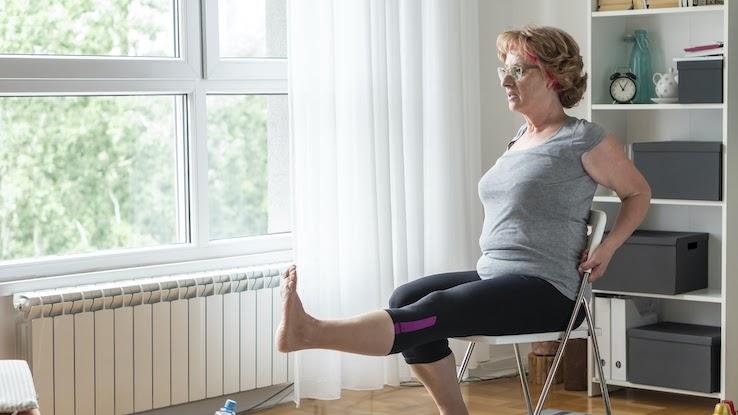
One way to get started is to practice chair yoga. Chair yoga exercises are a perfect way for you to stretch and get moving, all while you're safely seated in a chair — no need to get down onto the floor. This type of yoga can help loosen your muscles, improve circulation, build strength and even relieve stress. Even better? You can do it any time from the comfort of your own home.
Photo Courtesy: [SilviaJansen/E+/Getty Images]
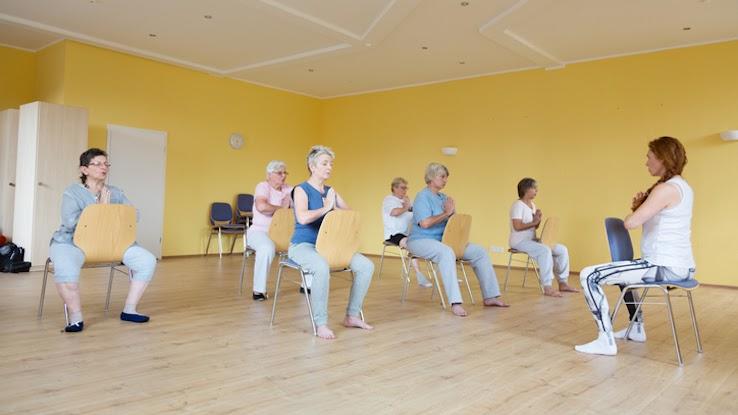
Chair yoga, or sitting yoga, for seniors is a modified version of traditional hatha yoga to help relieve body aches and stay healthy in a safe and accessible way. Hatha yoga is a form of this type of exercise that's more gentle and more slowly paced with a focus on stretching and breathing. It's ideal for anyone who lives with pain that could make more complex yoga poses difficult, such as chronic pain, osteoporosis and multiple sclerosis. Additionally, chair yoga can also be ideal for people who spend long hours sitting in a chair.
Many seniors find their lives become sedentary with each passing year because movement may become more tiring, uncomfortable or painful. Practicing chair yoga regularly can provide a way to prevent or relieve those issues. It's a low-impact way to get the blood in your body flowing and stretch your muscles.
In terms of equipment, all you need for chair yoga is a stable, armless chair. Make sure the chair is resting on a flat, stable surface and that you're wearing comfortable clothes that allow for a generous range of motion. Chair yoga can also be ideal if you're a wheelchair user.
Benefits of Chair Yoga for Seniors
Photo Courtesy: [RyanJLane/Getty Images]
Getting regular exercise can add years to your life and slow the aging process. However, many types of exercise can become more difficult to perform with age. High-impact exercises like weightlifting, running and other types of intense cardio can be particularly hard on your joints and muscles. Chair yoga provides a way to get your body moving without stressing your joints with hard impacts like running does. Practicing chair yoga for 20-30 minutes per session several times a week can provide significant health benefits.
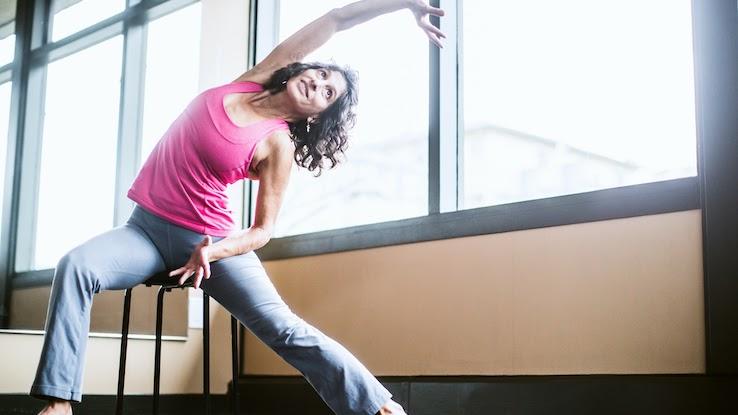
First of all, it can help manage and reduce pain. One recent study from the Journal of American Geriatrics Society found that chair yoga effectively helped relieve pain associated with osteoarthritis. Furthermore, chair yoga involves stretching the neck, upper back, lower back, shoulders, arms, legs, knees and ankles without much impact on the joints. This not only reduces stiffness, tension and pain, but it can also help to improve mobility in the long run.
Another potential benefit is improved flexibility, which can make it easier to perform regular movements as you go about your everyday routine. Being flexible also can improve muscle coordination and posture and lower the risk of future muscle soreness and injuries. Chair yoga helps improve your strength and balance as well, meaning falls become a lot less likely. Having a strong body also increases your ability to withstand injury.
Chair yoga even has benefits for your mental wellbeing. As with traditional yoga, chair yoga involves a lot of deep breathing, which can help clear your mind similarly to meditation. This often results in reduced stress, a better mood, less anxiety and a calmer state of mind.
Try These Great Chair Yoga Routines
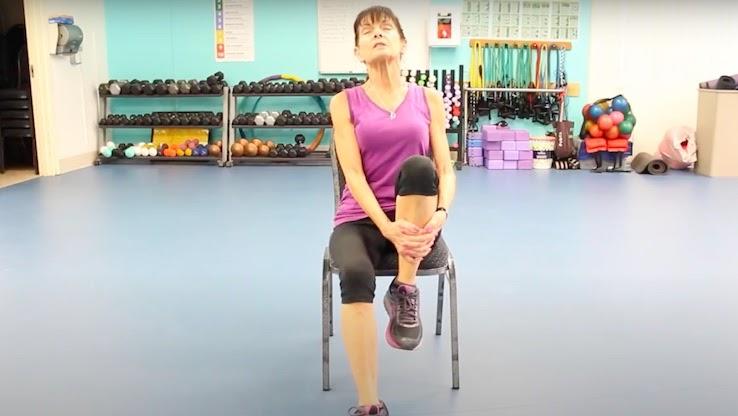
Photo Courtesy: [Fitness With Cindy/YouTube]
There's no need to leave your home, join a gym or go to chair yoga classes at a fitness studio — plenty of outstanding chair yoga routines are available online. Some are written out with pictures, while others are instructional video workouts you can follow along with.
If you're unsure about the idea of following along with a chair yoga video, you can simply make your own routine consisting of exercises sitting in a chair. Here are some great options for all skill levels:
The Forward Bend Pose involves bending over so your chest is resting on your thighs and your hands are reaching towards the floor. If you can, place your palms fully on the floor. To get the most out of this stretch, hold for 30 seconds or more, taking slow, long, deep breaths.
The Chair Pigeon Pose is another great chair yoga stretch. Sitting up straight with your knees aligned above your ankles, bring your left ankle to your right thigh. If you can, try bending forward as low as possible to make the stretch more intense. Hold here for several deep breaths before doing the same pose with the opposite leg.
For the Chair Spinal Twist, begin by sitting sideways on your chair facing right. Twist your torso to the right while grabbing the back of the chair with both hands to anchor yourself in that position. Stay here for several deep breaths. Then, switch to the left side.
The simple Overhead Stretch starts with you sitting up straight in your chair, facing forward with your arms relaxed and hanging by your sides. As you take a deep breath in, slowly begin to raise your arms up towards the ceiling. Once they're fully extended upward, take a moment to engage your core and ensure your back is straight. Hold this position for a few seconds. Let out a long exhale while slowly lowering your arms back down. Repeat this a few more times.
You might find it easier and more convenient to follow an exercise video routine that provides instructions and demonstrates the different positions for you. There are plenty of free chair yoga classes and routines for seniors to choose from. Here are some that come highly recommended:
Chair Yoga for Seniors With Adriene: Adriene is a master of making yoga fun and easy for everyone. In this 17-minute chair yoga video, she guides you through the moves slowly and clearly so that it's easy to follow along and enjoy learning the basics.
Gentle Chair Yoga With Mary Beth Kealy: This gentle, stimulating 41-minute chair yoga practice is great if you want to spend a little bit of extra time stretching. The background of the video incorporates soothing, meditative music to make the experience especially relaxing.
Chair Yoga for Lower Back Pain With Cindy: Cindy walks you through 18 minutes of sitting yoga for seniors. The stretches are specifically designed to ease lower back pain while helping you build strength at the same time.
The living room is one of the most important areas in your house for a great hosting experience. It's likely you and your guests will spend countless hours in this room, discussing and entertaining.
Decorating your living room properly will deliver deeply satisfying living for your leisure time. To get there, however, you must pay attention to all of the following areas:
1. the colors that you select
2. material and quality of seats and furniture
3. wall decorations and art
4. lighting and light fixtures
Below we show you some great ideas for decorating your living room.
The Best Colors for Your Living Room
One area that will have a disproportionate impact on the mood of your living room is the color you choose for the walls. While you can install wallpaper to change the look of certain walls, there are areas that wallpaper cannot cover. Getting the wall color right, therefore, gives you the best shot at creating a remarkable effect.
Some of the best color palettes for living rooms include:
1. White - White walls add a touch of class. They are the perfect backdrop for decorating with upscale furniture.
2. Turquoise - This color is great for creating an informal but refined feel. Your kids and family will love the refreshing mood this color creates.
3. Cream - Striking a balance between formal and informal, cream-colored walls create a quiet, soothing effect.
Furniture Choices
With your wall color selection made, you should select furniture that pairs well with the colors you've already chosen. For example, combining white couches with white walls will create resonance in your room design.
Make sure to provide ample seating to avoid crowding. Add multiple sofas, easy chairs and other seats that can accommodate a complete roomful of people, depending on the size of the room.
Furniture like TV stands and tables should generally blend in with the colors of the room and ceiling. There are some natural materials, however, that can work regardless of the colors on the walls. For example, wooden table surfaces look good whether your walls are white, blue or another color.
Lighting Ideas
You can greatly improve the aesthetics of a living room with bright lighting and impressive light fixtures.
To start, you can consider a beautiful chandelier in the center to provide light around the whole room. This central masterpiece ensures adequate lighting throughout the living room while adding an air of elegance.
You can then add to the light sources in the living room with individual lights on tables and around the walls in areas where people will not knock them down.
Carpeting
Consider adding carpeting to your living room to create a comfortable walking area. Carpeting lets you and your guests go barefoot if you choose. The living room almost demands this since you will want to take off your shoes and kick back on occasion. Warm plush carpets provide a good, comfortable surface for this. There are many choices when it comes to carpet size.
If your living room is very large, you can opt for wall-to-wall carpeting. On the other hand, if it's smaller, you can add just an area rug in the place where you will sit. For example, you can have a rug around the sitting and TV area where your kids will play.
The advantage of area rugs over wall to wall carpeting is, mainly, lower costs and ease of replacement. You can completely change the area rug and create a new aesthetic in a fraction of the time it would take to begin installing new wall-to-wall carpeting.
Art Ideas for Your Living Room
Many homeowners like to have some wall art in their living room. If your living room is spacious, it can accommodate a good-sized piece of art mounted alongside one wall. In some instances, you can consider multiple art pieces. Invariably, tasteful art adds to the sophistication of a living room. It adds an interesting item that sparks many conversations from impressed guests.
Selecting art is an opportunity to express your unique personality. If you are fairly conservative, you can select some classical type pieces that portray a quiet life. If you are more adventurous, you can experiment with a post-modern impressionist piece that others might consider risky. It's your space, and so feel free to decorate it to express who you are.
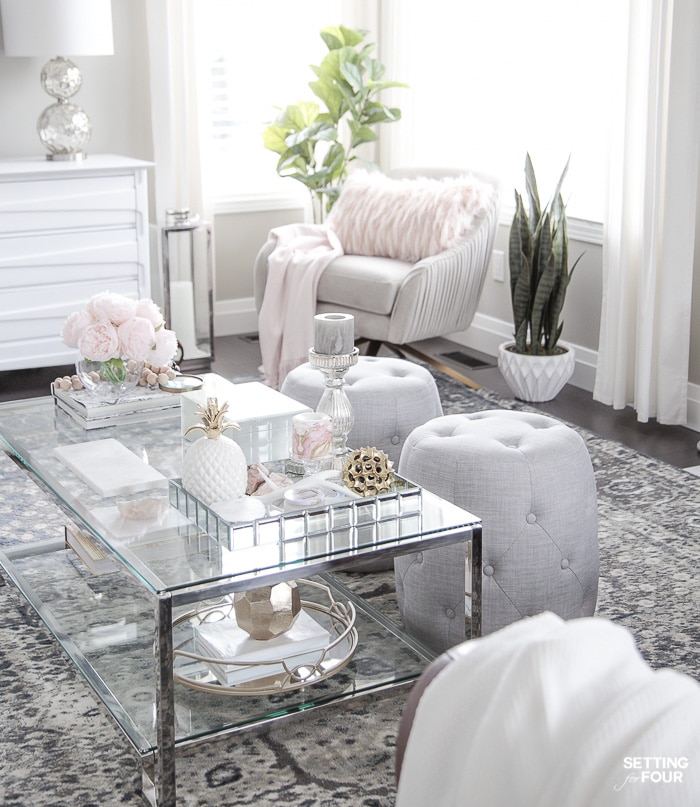
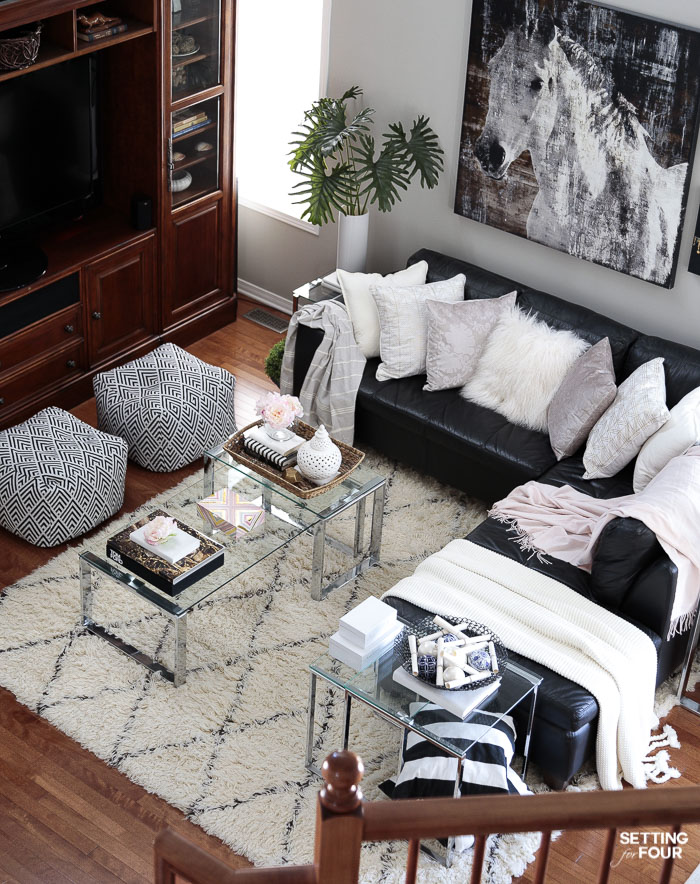
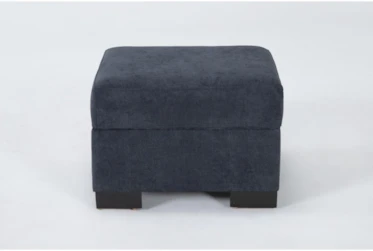
Poufs are timeless, multipurpose must-have furniture pieces to add function, personality, color and pattern to any room! See 8 ways to use a pouf ottoman in your home, many you wouldn't even think of! Poufs are so versatile!
This post contains affiliate links. Funds from affiliates help pay for web hosting, domain registration, email delivery, and other fees to keep settingforfour.com up and running. Thanks for your support!Click here to read my full disclosure policy.
8 Ways To Use A Pouf In Your Home
1. As a foot rest:
This is the most obvious way to use a pouf! Poufs are the perfect height and shape to rest your feet on while you are lounging in a chair or on the sofa.
2. As extra seating:
Pull a pouf up to a conversation area in a living room or family room for extra seating when you have company over. This works especially well for kids! Add a pouf to a kids bedroom or playroom as a comfy spot to read kids books!
Blush Pink and Neutral Decor Home Tour
3. As a coffee table:
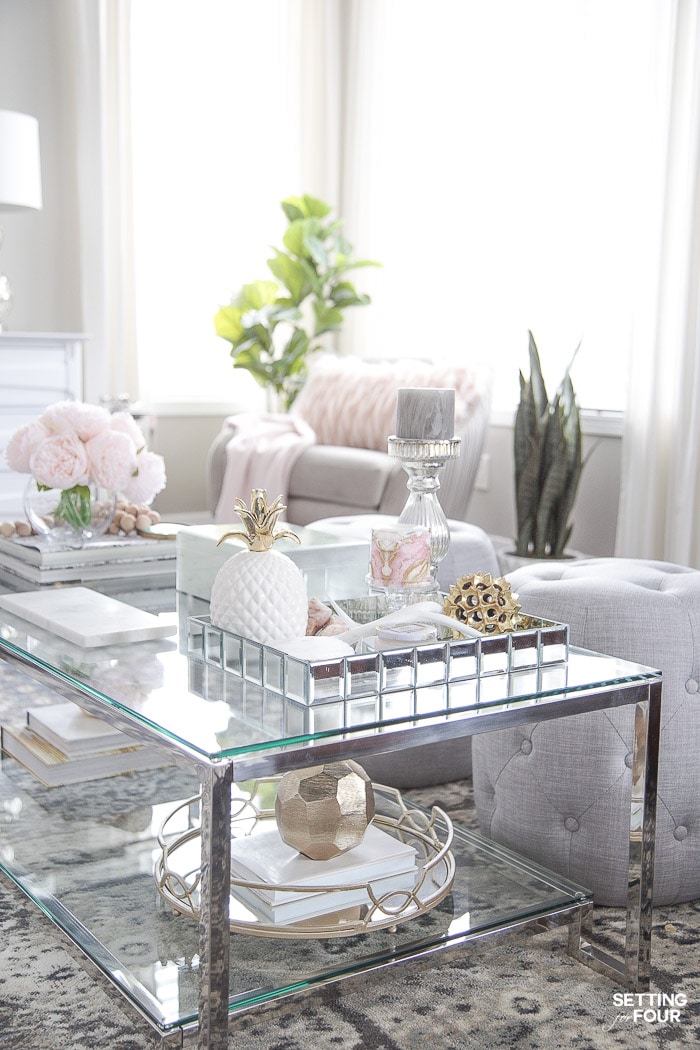
Use one, two or three poufs in a grouping as a coffee table! With their soft edges they make a perfect pet and kid friendly coffee table too. Add a tray on top to sit drinks on.
4. As an end table:
A pouf with a tray on top makes a great end table for a chair or sofa.
5. As a night stand:
Place a pouf by a bed as a nightstand. Add a tray to sit an alarm clock and water glass on.
6. As a pet bed:
Use a pouf as pet's bed (for cats and smaller dogs) – it will give your pet a cozy soft spot to perch and sleep!
7. Outdoors:
Did you know that there are outdoor poufs that are waterproof, fade proof and can be left outside? Use them outside on the porch, deck or patio for extra seating or as a table!
8. As a decorative accent to create a mood in your room:
Choose a pouf in a color and pattern that you love to display your personality and your style! How about a jute pouf if you love all things coastal? A global inspired pouf if you love the Boho look? Or a button tufted pouf like mine below if you love classic tailored looks!
Blush Pink and Blue House Tour
Shop these gorgeous poufs! Click on each image below to see more about each item!
PLEASE PIN THIS AND SHARE IT WITH YOUR FRIENDS!
Do you have any other uses for them?
You may also like:
15 Creative Ways To Use and Style A Bar Cart!
Easy Tabletop Decorations You Can Do In Five Minutes
Use these living room design ideas to make your living room a comfortable, inviting place to gather with family and friends.
1 of 10
1. Set the Mood with Color
100174484
The colors you choose for your living room will affect how guests feel in the space. Colors can energize or relax the space, depending on how intense they are and how warm or cool they are.
A serene scheme of soft blue and white makes this spacious living room feel calm, cool, and collected--a gracious setting for elegant gatherings. A light tan carpet underfoot warms the space and keeps the cool tones in balance.
Advertisement
Advertisement
2 of 10
2. Finish the Walls and Ceilings
Wallpapered room with fireplace
Traditionally, living room walls receive more elaborate or formal treatment than other rooms because the room is a public space. To make it a welcoming room that expresses your personality, choose wallcoverings or treatments that reflect your style.
The walls in this room are wallpapered with a chic print. The effect brings warmth and texture to the walls and gives them a look of antiquity.
3 of 10
3. Add Character with Architectural Trimwork
100109899.jpg
Trimwork serves practical purposes, covering the seams where floors and ceilings meet walls and supporting the structure around openings. But these elements serve aesthetic purposes too. The style of trimwork helps give your home a distinctive look, whether classical, contemporary, old-world, or regional.
Projecting lintels over the door and windows, a deep cornice, and a paneled and beamed vaulted ceiling combine to give this white-washed living room a sense of place.
Advertisement
4 of 10
4. Choose Stylish, Comfortable Flooring
SIP927446.jpg
In keeping with the function of the living room as a public space, choose a floor covering that provides comfort underfoot and makes a design statement as well. This vibrant wall-to-wall carpet lays the foundation for a refined mix of florals and stripes.
If you prefer a less bold floor, choose a solid neutral flooring that allows attention to focus on furniture or art. Hardwood floors with area rugs are one of the most popular choices for living room floors, but ceramic tile, stone tile, and full carpeting work too.
5 of 10
5. Create a Focal Point
living room - overall
A focal point anchors the living room and helps draw you into the space. A fireplace is a natural focal point, symbolizing hearth and home, but in most living spaces, the television is the true center of attention. To keep them from competing, pair them up. A beautiful view or a stunning piece of art can also serve as a room's focal point.
Here a the fireplace becomes the central point in this living room that features a simple and chic look.
6 of 10
6. Arrange Furniture for Conversation
100109605.jpg
Living rooms are gathering spaces, so use furniture arrangement to promote conversation and interaction. Pull seating pieces away from the walls and arrange them to face each other.
If you have a large living room, break it into two conversational groups for a more comfortable, intimate feeling. Chairs and ottomans that can be pulled into the group as needed allow you to expand the circle and still keep the intimacy.
Advertisement
Advertisement
7 of 10
7. Plan for Inviting Lighting
TDH723662.jpg
Lighting in the living room should be geared toward creating a relaxed, comfortable mood. Aim for layers of light, and position light sources so they form roughly a triangle to ensure good distribution of illumination.
Table lamps that focus the light down will encourage people to sit down and relax. The overlapping arcs of light illuminate the seating instead of the upper walls, sending the message to sit.
8 of 10
8. Dress the Windows--or Not
TDH721038.jpg
Although heavy window treatments are mostly a thing of the past, living rooms are the place for elaboration and luxury if you're so inclined. This combination of relaxed shades and floor-to-ceiling draperies is understated yet elegant.
The elegance comes from the generous use of fabric in the draperies--they're not fancy, but the thick folds and puddling ends communicate luxury. The shades block light and provide privacy when desired.
9 of 10
9. Design a Media Center
101356787
If your living room is also your family room, watching TV may be the main use of the room. Whether you have the newest model or an older one, incorporate it into the room's design so that it's a feature but not dominant.
In this living room, a built in bookcase is the perfect spot to accommodate the television.
Advertisement
10 of 10
10. Accessorize with Art and Collections
100109139.jpg
Living room walls come alive when you use them to display art or collections that you love. Group items for impact, and hang them low enough to relate to nearby furnishings or architecture. The most common mistake in hanging pictures is putting them too high.
This grouping of four large prints hangs low enough to connect visually to the sofa. The painting on the adjacent wall hangs at standing eye level and relates to the lamp in the corner.
At age 28, Randalf Dilla has created an 8' x 18.5' oil mural to help remind Filipinos of the dark side of the Martial Law years. Being only 28 years old, it is obvious that the artist has neither first hand knowledge nor experience of the Marcos regime. The painting therefore depicts only what Randalf has learned or heard from his own research. The dictator takes the central part of the mural with gold bars falling down in front. The Philippine flag appears to be used as a table cloth and portraits of military men cover part of the mural. But most of the canvass is really littered with images of victims of human rights abuses, hence, the work bears the title, "Salvaged Memories, Salvaged Lives".
Salvaged Memories, Salvaged Lives by Randalf Dilla (Hiraya Gallery)
Rose de la Cruz writes in the Manila Bulletin "Remembering Martial Law and the Value of Freedom". Two paragraphs in the article describe how some in the Philippines nowadays regard the Martial Law years.
To those who like to see the "bright side" in dark days, the curfew was a good thing because it brought children and husbands home by midnight, and sort of offered a "safer" night with people not allowed to move around.
Many say people were most disciplined then, especially in traffic, because of the presence of uniformed men. The incidence of crime was low, again because of police visibility – and the possibility that one may "disappear" for a long time. Young adults, especially are awed when one tells them about the bus marshals who rode in the buses, ready to shoot holdup men.
It is disillusionment, a totally misguided nostalgia. What has happened and is happening in the Philippines is perhaps similar to what other countries have experienced after a period of authoritarian rule. Escaping from a dictator often does not translate automatically to a birth of a genuine democracy especially when one's eyes are fixed on the rear-view mirror of escaping authoritarianism, utterly failing to see what responsibilities democracy commands ahead.
..despite three multiparty elections since the 1990s, the government, which succeeded Banda, has failed to broaden the avenues for the consolidation of democracy in Malawi, leading to disillusionment among the people. Ten years of multiparty democracy have only resulted in the regression to the practices of the very regime it replaced. Currently Malawi is plagued with a lack of independent media, weak civil society, corruption among top government officials and a weak economy to mention a few. The thesis argues that this is because of the nature of the ruling class as well as the issue of ethnicity, which has resulted in the contestation of power.
"Sa ikauunlad ng bayan, disiplina ang kailangan" (For the country to progress, discipline is needed) I am at least relieved that Rose de la Cruz followed the two nostalgic remembering of Martial Law with this:
But that was not 'discipline' being practiced but fear for the authorities who had the power to detain you for any perceived fault – from jaywalking to subversion to illegal possession of firearms. Though that kind of atmosphere made one live in fear of being arrested, it also made people follow the rules.
Martial Law must be remembered, but not for the wrong reasons. We should not remind ourselves of the past regime to hide the fact that we have not moved forward. Human rights abuses continue and so does large scale corruption. Likewise, we should not return simply because we have not found our way forward,
Designer Amber Lewis Gave This Worn Living Room The Country-Cool Vibe it Needed
Published on Nov 20, 2020
Design: Amber Lewis, Photo: Tessa Neustadt
If there's something we never get tired of seeing, it's a great makeover. Whether it's transforming a retro bathroom into a modern oasis or giving a lackluster bedroom a fresh look, pros perform these design miracles all the time.
To give designers a chance to showcase their favorite makeovers—and to bring you plenty of inspiration for your own home—we're sharing the best before and afters we've seen in our series, Makeover of the Week. Take notes for your next renovation.
"The living room is the first thing you see when you enter the house, yet in this Connecticut home, it was dated and in need of a major refresh," interior designer Amber Lewis shares. "My goal was to marry upscale farmhouse style with a cool country vibe, creating a traditional-yet-cozy aesthetic for this family with four small children."
Meet the Expert
Amber Lewis, founder of the Los Angeles-based Amber Interior Design and Shoppe Amber Interiors retail stores, is known for her laid-back and light-filled décor that incorporates colorful textiles, earthy textures, natural elements, and brushed metals.
Before:
Courtesy of Amber Lewis
"The wood paneling combined with the ceiling beams and dark floor gave the space a heavy, cabin-like feel," Lewis notes. "Our first goal was to immediately brighten things up."
After:
Design: Amber Lewis, Photo: Tessa Neustadt
"We removed most of the wood paneling and the ceiling beams, painting everything a crisp white instead," Lewis says. "Then, we lightened up the original chocolate-stained white oak floors to give them a more natural, fresh finish. By filling the room with a mix of modern and vintage pieces, we created an airy and inviting space where everyone can hang and relax."
What Changed:
Color theme: A mix of whites and punches of gray and navy create a warm and inviting color palette.
Couch: The deep-seated ivory colored sofa has a mid-century feel and is covered in blue and rust-colored pillows.
Chairs: The caramel leather chairs feature padded arms with a cool buckle display.
Fireplace: The original wood mantel adds texture to the space and is filled with an array of vintage artwork and tchotchkes.
Windows: Bare windows allow for maximum light and contribute to the simplicity of the space.
Vintage furniture: Accent pieces, like the coffee table, dresser, and spindle-back chair are all vintage finds that that add character to the room.
Bench seating: Built-in nooks on each side of the fireplace provide a place for the kids to curl up.
Lighting: The milk glass on the two brass swan neck wall sconces create a soft glow and illuminate the area above the built-ins.
Rug: The vintage-style patterned rug grounds the space with its shades of dark blue and light gray.
Pocket doors: Sliding pocket doors, installed to create a divide between the living and kids' play area, are in keeping with the home's age.
Stools: Woven stools provide a place for the family to rest in front of the fire.





:max_bytes(150000):strip_icc()/53930624-0000-LT0070-WWAL_b2-444aa4077b0b481ea76c6a17b4193b40.jpeg)
:max_bytes(150000):strip_icc()/Shoppe-amber-interiors-mabel-Edit_1080x-a3e6187aa49d47c8b28754c05a8a6f50.jpg)
:max_bytes(150000):strip_icc()/shoppe-amber-interiors-billie-sofa-acorn_900x-80bdbdcf0a1a470cac8e2d2af950311d.jpg)







 Shopping Basics Clearance Furniture: Frequently Asked Questions
  Getting Social Learn to Live Luxe for Less with Copy Cat Chic
  Getting Social 5 Small Space Design Tips from Jeremiah Brent
  Guides Furniture Lifespan Guide: When to Replace Your Furniture


